

What if the only thing standing between taking charge of your life and following your dreams was giving yourself permission?
INTRO
Artificial Intelligence (AI) is here to stay. Should you hate it? fear it? ignore it? embrace it?
To be clear, I’m not referring to “deepfake” videos whose goal is to spread disinformation. My concern, my special interest, is that of a storyteller wondering whether creatives can employ AI to produce complex, nuanced narratives.
If you are on the fence, this short (6 min) YouTube video (“The Waiting Room”) not only dramatizes an enduring existential insight but may also help you decide the AI question.
I would suggest watching the video first, then scroll down to encounter additional context designed to enhance your curiosity.
THE WAITING ROOM
Brad Clark, AI Storyteller
QUESTIONS
Having watched this video – keeping in mind that every pixel was AI generated – you might ask yourself:
Did the overall production seem generic, formulaic, or in any way “robotic”?
Did the characters seem to portray emotions appropriate to the story?
Did the narrative arc seem to arise out of a “human touch” – i.e., guided by some sort of artistic intent?
AI CONTEXT
The most frequent disparaging of creative AI videos is that they are “incapable of interpreting complex emotions, cultural nuances, or artistic intent.”
Software engineers know this, and toward that end generative models are evolving almost daily, constantly pushing the technical limits of what AI video models can achieve. Your answer to the above questions will shape how you view AI’s progress so far.
What is an AI generative video model? It’s an algorithm trained on vast datasets to create new, original content from a prompt – such as a text prompt describing exactly what kind of video you want. You “prompt” AI, it responds.
Obviously, how well you finesse your instructions dictates how good the generated video will be. Often you have to keep tweaking your text prompt to get better and better results.
A 2025 Gallup Report has found that nearly one-third of teachers have introduced students to prompt writing, which is now considered a form of digital literacy, an essential skill for students to learn.
It should be noted that AI-generated video is widely expected to augment and transform the work of creatives, rather than entirely replace them. The consensus among industry experts is that AI is a powerful tool that automates repetitive and technical tasks, allowing human professionals to focus on higher-level creative direction, storytelling, and emotional nuance.
EXISTENTIAL CONTEXT
Although nowhere in the YouTube description or credits is mention of Franz Kafka, notice some striking similarities:
“The Waiting Room” is a surreal drama (2025) by Brad Clark about characters trapped in a cycle of endless waiting, paralyzed by the comfort of inertia, who must decide if they are brave enough to walk through the unlocked door and pursue the life they want to live.
“Before the Law” is a parable embedded in Kafka’s novel, The Trial (1915), about a man who arrives at a gate wishing to gain entry, but despite the gate remaining open the gatekeeper denies him entrance. He waits his entire life for permission to enter only to learn on his deathbed that this entrance was “assigned only to you,” and then the door closes forever.
In a similar vein French Existential philosopher Jean Paul Sartre says we create ourselves through the choices we make, and thus ought to choose wisely in order to “be all that we can be.”
POSTSCRIPT
By way of explanation I should mention that the above video showed up in my YouTube feed and I randomly clicked on it. Two things jumped out at me:
1. Subject matter: Existential undercurrent plus the Kafka parallel – because I am familiar with both.
2. AI technology: Using generative video models to create a visual narrative – because I am currently obsessed with teaching myself that very skill.
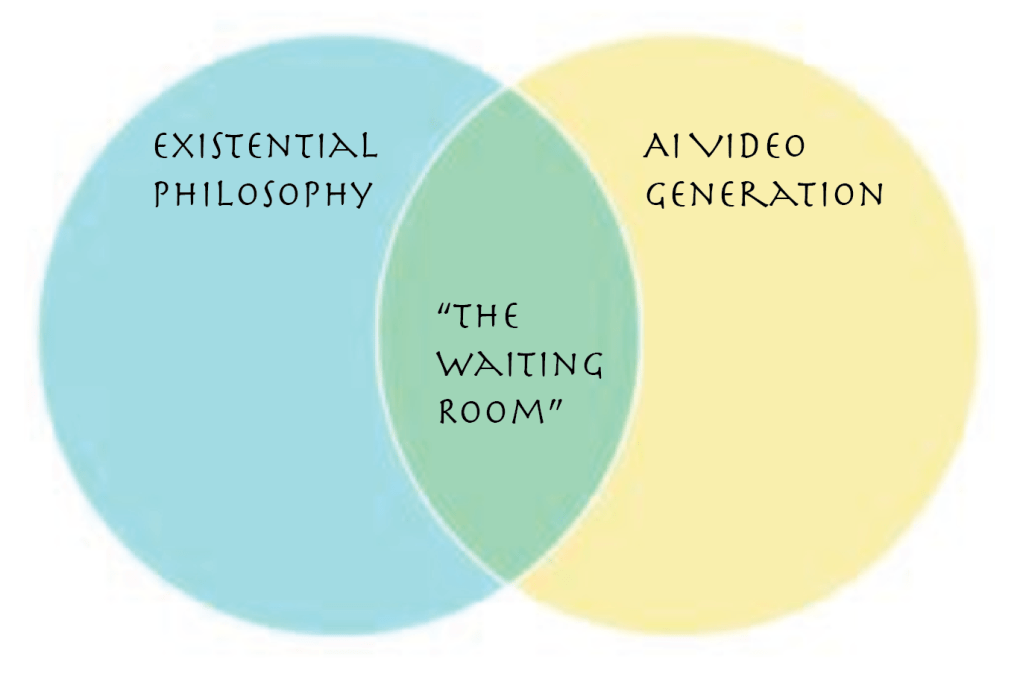
These two concerns seemed joined at the hip like interlocking Venn diagrams crying for recognition.
 giblets & flapdoodle